The Evolution of PDF Translation: From Manual to AI-Powered Solutions
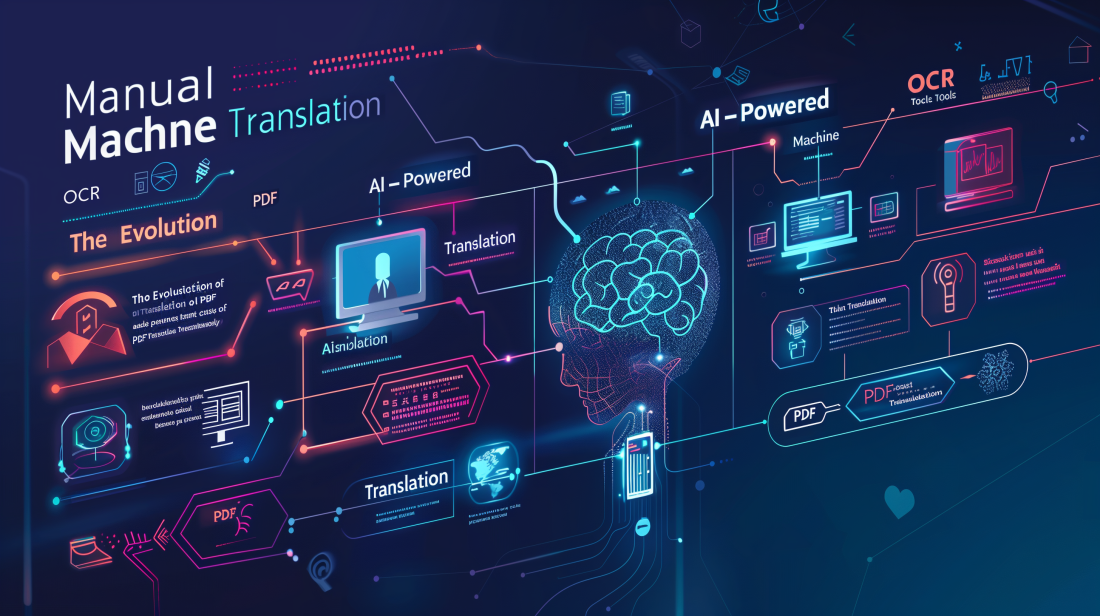
In our increasingly globalized world, the ability to quickly and accurately translate documents has become crucial for businesses, researchers, and individuals alike. Among the various document formats, PDF (Portable Document Format) has emerged as a standard for sharing information across different platforms and devices. As the need for translating these documents has grown, so too have the methods and technologies used to accomplish this task. Let's explore the fascinating journey of PDF translation, from its humble beginnings to the cutting-edge AI-powered solutions of today.
The Early Days: Manual Translation
In the early days of PDF usage, translation was primarily a manual process. Translators would need to read the PDF document, often retyping the content into a word processor, translate it manually, and then recreate the formatting in the target language. This method was time-consuming, prone to errors, and often resulted in layout issues due to text expansion or contraction in different languages.
The challenges were numerous. PDFs could contain complex layouts, images with text, and even scanned documents that were essentially images of text. Translators had to juggle between maintaining the original format and ensuring accurate translation, often leading to compromises in either quality or presentation.
The Rise of OCR Technology
A significant breakthrough came with the advancement of Optical Character Recognition (OCR) technology. OCR allowed computers to "read" the text in PDF documents, including those that were scanned or image-based. This development meant that translators could now extract the text from PDFs more easily, although the process still required manual intervention to correct OCR errors and handle formatting.
OCR technology gradually improved, becoming more accurate in recognizing different fonts, languages, and even handwritten text. This improvement streamlined the translation process, reducing the time needed for text extraction and allowing translators to focus more on the actual translation work.
Computer-Assisted Translation Tools
The next major step in the evolution of PDF translation was the integration of Computer-Assisted Translation (CAT) tools. These tools included translation memories, which stored previously translated segments, and terminology databases. When combined with OCR technology, CAT tools allowed for more efficient translation of PDFs.
Translators could now work directly with the extracted text, leveraging past translations and ensuring consistency across documents. However, the process still required significant human intervention, especially for maintaining the original PDF layout and handling complex formatting.
The Advent of Machine Translation
The introduction of machine translation (MT) engines marked another leap forward. Early MT systems, based on statistical models, could provide rough translations of PDF content. While far from perfect, these translations could serve as a starting point for human translators or provide a gist of the document's content for readers who needed quick understanding.
As MT technology improved, particularly with the introduction of neural machine translation (NMT) systems, the quality of automated PDF translations increased dramatically. These systems could better understand context and produce more natural-sounding translations.
AI-Powered PDF Translation: The Current State
Today, we stand at the forefront of AI-powered PDF translation solutions. These advanced systems combine several technologies to provide a seamless translation experience:
Advanced OCR: AI-enhanced OCR can accurately recognize text in various languages, fonts, and styles, even in low-quality scans or complex layouts.
Neural Machine Translation: State-of-the-art NMT models provide high-quality initial translations, often approaching human-level quality for certain language pairs and domains.
Layout Preservation: AI algorithms can analyze the original PDF structure and maintain it in the translated version, handling text expansion and contraction automatically.
Image and Graphics Translation: Some advanced systems can even translate text embedded in images and graphics within PDFs.
Quality Assurance: AI-powered tools can detect potential translation errors, inconsistencies, or formatting issues, flagging them for human review.
These AI-powered solutions have dramatically reduced the time and effort required to translate PDFs while significantly improving quality and consistency. They enable real-time translation of large documents, making it possible to quickly understand and share information across language barriers.
The Future of PDF Translation
As we look to the future, the evolution of PDF translation shows no signs of slowing down. Emerging technologies like adaptive AI, which can learn from user corrections and preferences, promise even more accurate and personalized translations. We may soon see systems that can handle multimedia PDFs, translating not just text but also audio and video content embedded in documents.
The journey from manual translation to AI-powered solutions has transformed PDF translation from a painstaking, time-consuming task into a rapid, efficient process. As these technologies continue to evolve, they will undoubtedly play a crucial role in breaking down language barriers and fostering global communication and understanding.
Back to blog